
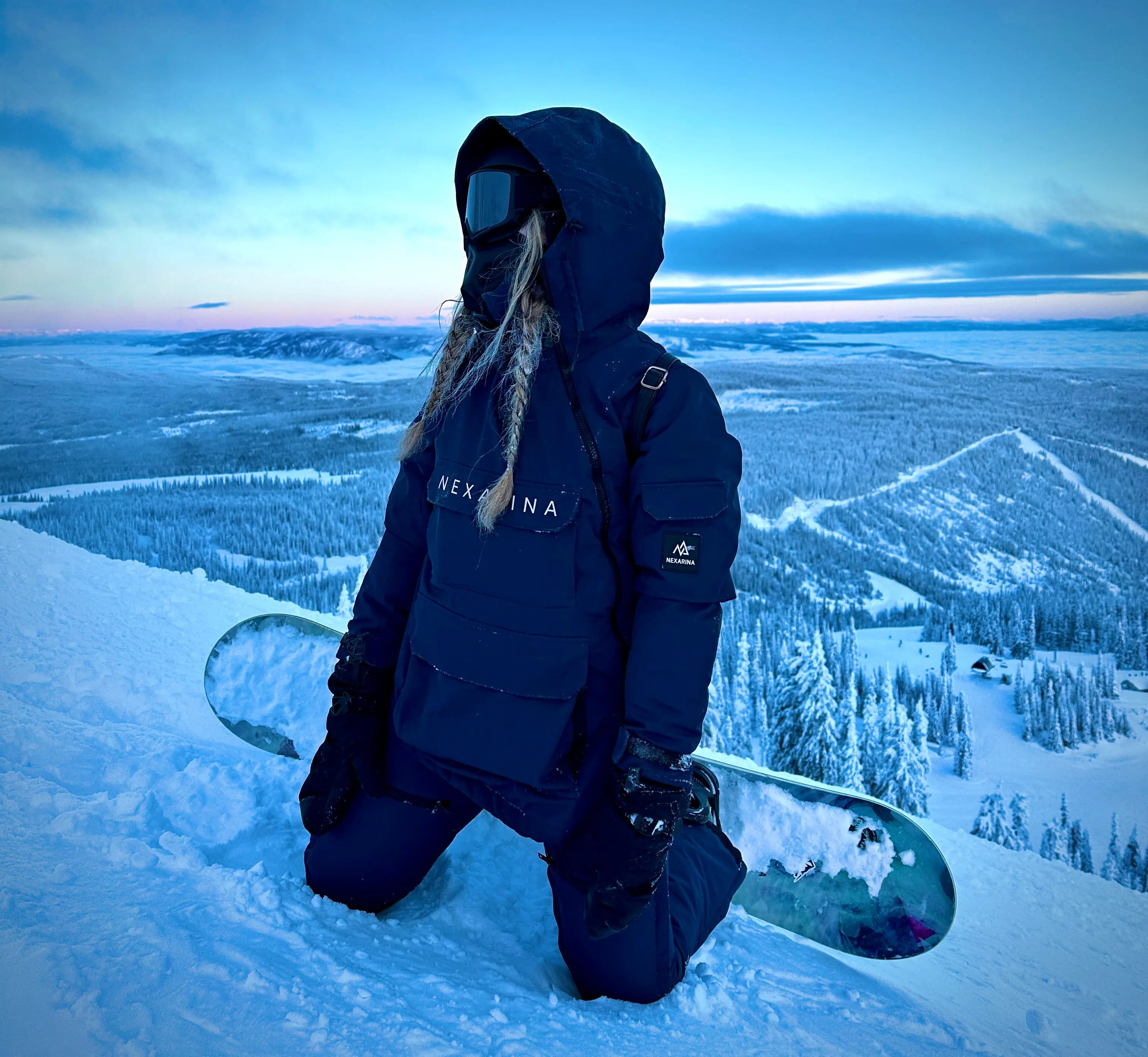
Women's Snowboard Outerwear: What to Look for Before You Buy
The 8 things that decide whether you stay warm, dry and comfortable all day, from your hood down to your hems.
 Nexarina outerwear · Short, Regular + Tall
Whether you ski or snowboard, start with waterproof, breathable fabric and fully sealed seams. Then match the insulation to how cold you run, and choose the right length, not just the right size. Finally, check for room to move, vents you can use with gloves on and snow protection where your jacket and pants meet.
8 things to look for
What each one means and what to check on the tag.
-
01
Waterproofing
Snow melts on contact with your body heat. You sit in it on the lift, kneel in it to strap in and land in it when you fall, so your gear has to hold up all day.
Look for20,000mm+ with fully sealed seams -
02
Breathability
Waterproof isn't enough if your sweat can't get out. It builds up inside, so you end up damp on the run and freezing on the next chair.
Look for10,000g+ breathability, with a membrane like eVent® -
03
Warmth
How much insulation you need depends on how cold your days are and whether you run hot or cold. Synthetic fill keeps you warm even when it gets damp.
Look for60g to 100g of PrimaLoft® for Canadian winters -
04
Length
Most brands make one length and expect you to make it work. Too long and your pants drag and bunch. Too short and snow gets in at your boots.
Look forShort, Regular + Tall lengths -
05
Room to move
You should be able to squat, reach for the bar and sit with your knees up without anything pulling tight or your jacket riding up.
Look forArticulation + stretch panels -
06
Vents
A hike, a sunny afternoon or a hard run heats you up fast. Vents let you dump that heat without stopping to take layers off.
Look forPit zips + thigh vents you can open with gloves on -
07
Snow protection
Snow gets in where your pieces meet: your wrists, your waist and the tops of your boots. Seal those gaps and most of the cold goes away.
Look forBoot gaiters + a powder skirt or bib -
08
The details
The small stuff is what you notice every chair ride: where your phone lives, whether your hood fits over your helmet and whether you can be seen.
Look forHelmet hood, warm media pocket + reflective details
Not sure where to start?
Tell us your height and how you ride. We'll match your length and piece.
- Takes 2 minutes
- Free exchanges
Match it to your days on snow
Where you ride changes what matters most.
Resort + local hill
Cold chairlifts, then hard runs. You need warmth for the lift and vents for the way down.
Backcountry + sledding
Skinning and digging out a sled heat you up fast, and you spend a lot of time kneeling in snow.
Park + freestyle
Lots of sitting, strapping in and falling. You need room to move and fabric that can take it.
What do outerwear specs mean?
Waterproof ratings, grams, 2L vs. 3L and more. See the tech behind Nexarina.
How much water pressure the fabric holds back. 10,000mm handles light snow. 20,000mm and up handles wet snow and sitting in it all day.
How many grams of sweat vapour can pass through a square metre of fabric in 24 hours. Under 10,000g is fine for casual, cold days. 10,000g and up is what most riders should look for. Ours is 15,000g, so you stay dry even when you hike, ride hard or run warm.
How many layers are bonded together. 3L is the most durable and breathable. 2L has a loose liner inside.
Grams of insulation per square metre of fabric. More grams means more warmth. For resort days in Canada and other cold climates, 60g to 100g is the sweet spot.
Tape over the stitching so water can't sneak through the needle holes. "Critically taped" means only some seams are.
The coating that makes water bead off the outside, without the "forever chemicals."

I took this one to Switzerland, Montana, and have worn it riding in Banff when it's been -30, and I've never been cold!
Built to check every box.
Fit and performance, no compromise. Every piece is tested through Alberta winters.

- eVent® fabric: 25,000mm waterproof, 15,000g breathable
- PrimaLoft® warmth, even when damp
- Short, Regular and Tall in every piece
- Stretch, articulated and adjustable
- Vents, boot gaiters and scuff guards
- Helmet hood and HeatSphere media pocket


Avani Pant for easy on and off. Everette Bib for more coverage. Pair either with the Indy Jacket.
Make it last
A little care keeps it waterproof and breathable for years.
Wash it when it's dirty
Sunscreen, dirt and body oils clog the fabric, so it breathes less and stops repelling water.
Skip the softener
It coats the fabric and stops it from breathing.
Follow the label
Technical fabrics and insulation each need their own wash and dry settings.
Watch the beading
If water stops beading on the outside, refresh the DWR. Knees and seats go first.
Women's snowboard outerwear FAQ
What riders ask me most before they buy.
What waterproof rating do I need for snowboarding?
Go for 20,000mm or higher, with fully sealed seams. Lower ratings can be fine on a dry, cold day, but you'll feel it the first time you sit on a wet chairlift or ride spring slush.
How much insulation do I need for Canadian winters?
Most riders are comfortable with 60g to 100g of synthetic insulation on resort days. If you run cold or spend a lot of time on chairlifts, go toward 100g. If you run hot or hike a lot, stay closer to 60g and use your vents.
Won't insulated outerwear be too hot in spring?
Not if it breathes. You overheat when your gear traps heat and sweat. A breathable membrane like eVent® lets that moisture out, and pit zips and thigh vents let you cool down fast, so you can ride the same kit from December through April.
Is snowboard outerwear different from ski outerwear?
Not much. The tech is the same: waterproofing, breathability and insulation. Snowboard pants usually have a little more room in the seat and knees, since you sit and kneel more. Everything Nexarina makes is built for both.
What if I order the wrong size or length?
Exchanges are free. If your size or length isn't right, we'll swap it. Here's how it works.
So, what should you buy?
Don't decide on one number or one feature. The right outerwear keeps you dry, matches how warm you run, fits your length and moves with you, so you can stop thinking about your gear and just ride.
Shop Nexarina outerwearMikayla, Founder of Nexarina